Wednesday, August 15, 2012

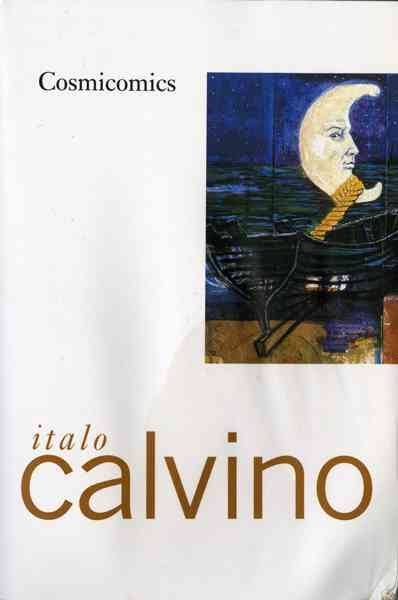
Italo Calvino’s Cosmicomics


New Spaces in Space:


Italo Calvino’s Cosmicomics


Originally Published on About.com’s Classic Literature Page


The author of such dazzling fictional inventions as Invisible Cities and If on a winter’s night a traveler, Italian writer Italo Calvino has often been cited as one of the first true postmodernists. Like nearly all the postmodernists of the 1960s—Thomas Pynchon, Cynthia Ozick, Gabriel García Márquez, etc.—Calvino was profoundly influenced by the new fictional forms created by the Argentinian short-story writer and essayist Jorge Luis Borges, but of all these writers, Calvino followed this new thread of genre-bending to the farthest extremes and spun his literary pursuits into the most fantastical and fabulous fictional webs.

Calvino began his literary career in the 1940s as a realist, with World War II and its political backdrop as his main subject and influence, but he eventually grew disillusioned with the limits of conventional narrative, which didn’t allow him to express his true artistic talents and desires. In the 1950s he published The Cloven Viscount and The Baron in the Trees, both of which were marked steps into a stranger and more warped fictional territory, and by the 1960s his works were mapping their own unique terrain around themselves and exploring the limits of fiction by exploring the limits of our collective ability to explore. While all this exploration would culminate in 1979, just a few years before his death, with the brilliantly exhaustive meta-fiction If on a winter’s night a traveler, in 1965 Calvino set his sights on the universe itself with his short-story collection Cosmicomics.

Cited as a breakthrough influence by the American postmodernist John Barth—who writes that when he discovered Calvino he was “much under the spell” of Borges—Cosmicomics takes on the farthest reaches of humanity’s knowledge of the universe and spins a series of twelve stories that each riff off of a different aspect of how our cosmos seems to be composed. While all the stories shape themselves around scientific concepts that in 1965 were held to be more-or-less factual, they’re also fantastically inhabited by living beings and consciousnesses that try to understand themselves and their environment—with a sentient and ever-changing being named Qfwfq narrating most of the stories (a clear reference to Kafka, and to Borges’ reference to Kafka in his story “The Library of Babel”)—and it’s the relationship between scientific understanding and living experience that gives these stories their poignancy and purpose.

In “The Aquatic Uncle” Qfwfq recalls the generational differences that sprang up when most of his family moved from the seas to the mainland. His great-uncle N’ba N’ga chose to stay in the water rather than make the shift from amphibian to reptile, and although Calvino’s anthropomorphization of this choice is scientifically spurious, when the interests and allegiances of Qfwfq’s girlfriend Lll come into play, the story resounds with the sadness and yearning that we all recognize when faced with diverging life-paths. Similarly, in “The Form of Space” Qfwfq falls endlessly through the empty cosmos alongside both a beautiful woman named Ursula H’x and his rival for Ursula, Lieutenant Fenimore, the story playing on the inner machinations and feelings of isolation that can arise when paralysis allows a simple love triangle to become infinitely complex. Qfwfq dreams of a universe coming into existence that will somehow impose a new form on space and bring him into contact with Ursula—and into probable conflict with the Lieutenant—but in the meantime he must continue falling and waiting and thinking, possibly forever.

A few years after the publication of Cosmicomics Calvino would befriend French semiotician Roland Barthes (not to be confused with John Barth, who took great exception to Barthes’ conception of “the death of the author”), and two of the stories in Cosmicomics play on the idea of signs in a way that correlates to some of the postmodern theory that Barthes and other French theoreticians were exploring at the time. In “A Sign in Space” Qfwfq leaves a sign in a specific point in his revolving galaxy to mark where he was and to serve as a reference point for all other spaces. When the galaxy turns full circle again and again, however, he finds his sign missing, or altered, or effaced, or copied, or mimicked, so that he loses his bearings in a universe where significance is elusive and relationships are relative to the point of meaninglessness. Like much of the theory it reflects, this story is little more than a self-conscious word game, but it bends the space that a short story can inhabit and enlarges the form in exciting and novel ways.

In the collection’s more successful story about signs, “The Light Years,” an unnamed narrator looks through his telescope and sees a sign that says, “I SAW YOU.” Calculating the time that it would take for the light to get to him from the sign’s location, he then calculates back and discovers in his diary that whoever posted the sign saw him on the very day that he’d done something that he didn’t want anyone to know about. This inaugurates a campaign of signs between the narrator and a universe full of observers and interlocutors who all have something to say about the subject. The narrator’s sense of shame and fear of being observed recalls some of Kafka’s most memorable characters, and as in “A Sign in Space,” the story’s compulsive thoroughness weaves a Kafka-like web of nightmare that its isolated narrator can’t escape.

Any comparison to Kafka and Borges in no way diminishes Calvino’s accomplishments, but instead points out his power to expand upon their innovations and to create new spaces for himself, which is no mean feat among such company. Like Borges especially, Calvino has the ability to run with a theme and expand upon it to seemingly infinite degrees. In his 1972 novel of interrelated sketches, Invisible Cities, he would take the theme-and-variation technique to his highest and most personal level, with each of the book’s city-states perhaps signifying a concurrent version of his beloved Venice, the book standing alongside If on a winter’s night a traveler in both innovation and fully realized achievement. Cosmicomics may not succeed to such a marvelous extent as Calvino’s later works, which are dizzying, but as with humanity’s understanding of the universe, this book’s reach exceeds its grasp in ways that profoundly compel and that lead to self-discovery for its readers and its writer alike.


—David Wiley


Friday, June 1, 2012

Vladimir Nabokov’s Selected Poems


A Review of Vladimir Nabokov’s


Selected Poems


Originally published in the Rain Taxi Review of Books, Summer 2012


Selected Poems
Vladimir Nabokov
Edited by Thomas Karshan
Knopf ($30)


A novelist, short-story writer, memoirist, critic, playwright, translator, biographer, correspondent, and poet, Vladimir Nabokov was one of the twentieth century’s most wholly accomplished writers. His contributions to nearly all of his chosen forms were both far reaching and profound, and almost no genre that he touched remained unchanged by his brilliant hand. Lolita and Pale Fire forever altered what could be done with the novel; Speak, Memory stands as the consummate literary autobiography; his literal translation of and notes to Alexander Pushkin’s verse-novel, Eugene Onegin, are a towering monument of scholarship and a singular (if controversial) contribution to the art of translation; his interviews and essays and lectures present one of literature’s most penetrating minds and voices; and his collected correspondence with critic Edmund Wilson forms one of the most moving and heartbreaking portraits of friendship ever documented. In nearly every genre, Nabokov was sui generis.

As with his great contemporary (and perhaps only peer), Jorge Luis Borges, Nabokov’s first love was poetry, and as was the case with Borges, it was in this one elemental genre that Nabokov succeeded the least. Edited and annotated by Thomas Karshan, Nabokov’s new Selected Poems collects his most interesting and representative specimens—less than one hundred out of literally thousands of poems—and presents them to the curious reader like a special drawer of Nabokov’s pinned and labeled butterflies. Or, perhaps, like a patient etherized upon a table.

Encompassing Nabokov’s 1970 collection Poems and Problems (minus the chess problems, regrettably), Selected Poems also collects several dozen previously untranslated Russian poems from as early as 1914, when Nabokov was fifteen, as well as nine previously uncollected English poems from as early as 1922, when Nabokov was at Cambridge. Nabokov’s son Dmitri translates the Russian poems that weren’t already translated by Nabokov himself, and Karshan provides an extremely well informed and mostly lucid introduction to the volume, along with just-shy-of-authoritative bibliographical and compositional notes for each poem, generously including Nabokov’s own notes and comments and letter-excerpts whenever available.

The collection begins with the 1914 poem “Music,” which describes a fountain surrounded by the attentive presence of hovering dragonflies and evokes the renewal of souls in a shimmering image of artistic purity. Perhaps recalling the soul-encircled fountain at the end of the Divine Comedy, this early piece is in many ways as good as Nabokov’s poetry gets, creating a delicately balanced image of diaphanous clarity that builds to a kind of epiphany about the nature of artistic creation:


                        With its delicate plashing the fountain
                        has dissolved the sinister shade—
                        the dragonflies’ counterpoint mounting
                        were sparse echoes now-sparkling souls made.


Many of Nabokov’s poems feature an artist such as himself reflecting upon the creative process, and so the poems end up not as an unconnected series of singular inventions (the way most of his novels do), but as interior snapshots of the artist’s thoughts and feelings and experiences. Occasionally the artist-figure in the poems is an altered or ironic or “impersonal” version of their creator, but as a whole we’re meant to feel Nabokov’s own reflections upon whatever image or memory or narrative he conjures up for us in each poem. This surprisingly naive approach places Nabokov’s poetic mode firmly in the Romanticism of the previous century, with many poems reading like nostalgic evocations of Wordsworth or Coleridge or Keats.

At Cambridge between 1919 and 1922, Nabokov studied classic Russian prosody and rejected the innovations of Modernism, both in Russian and in English. In contemporary Russian, Nabokov admired Bunin and Khodasevich (see Nabokov’s final Russian novel, The Gift, for a detailed view of his poetic ideas and tastes among his Russian contemporaries) and only grudgingly admired the talent (but not the innovation) of Pasternak. Likewise in English, he was an admirer of the Georgian Poets, whose forms and modes were a starkly conservative contrast to the newly emerging inventions of Eliot and Pound, both of whom Nabokov despised and ceaselessly derided throughout his life. Fascinatingly, the magic High Modernist year of 1922 produced both Ulysses, which Nabokov revered as perhaps the greatest of all English-language novels, and The Waste Land, which Nabokov thought ludicrous, and this divergence in taste tellingly marks Nabokov’s own artistic destiny. Within a few years, he largely set aside poetry and focused his main efforts on novel-writing, which he would pursue with a mind-bending boldness and a curiosity that was entirely lacking in his poetry.

His poems thus stand as tiny windows into the mind of a great artist in creative or personal or historical reflection, and even though few of them are terrifically remarkable in and of themselves, they offer delicious glimpses of a man whose persona is often as rich a presence to his readers as are his works themselves. To the devoted Nabokovian, these glimpses add vivid texture to the life and inner self found in his memoir, letters, interviews, and lectures. One of the more significant early poems, “The University Poem,” is a thirty-five page verse novella inspired in form and content by Eugene Onegin, and in it Nabokov narrates a languid and melancholy first-person account of a young Russian exile’s experiences at Cambridge. Not exactly the dilettante/dandy of Eugene Onegin (and not exactly Nabokov, either), the narrator is a listless rememberer whose fatalism colors a necessarily short-lived love affair, with the poem subtly reflecting on the narrator’s and author’s temporary sense of life disconnected from their original country and language.

Intensifying this old-fashioned reflections-of-the-poet approach, Dmitri Nabokov’s translations employ all manner of archaisms and even impose forced rhymes in order to mimic the originals (a technique at complete odds with his father’s iron-fisted rules for translation). The poems translated by Nabokov himself, as well as those originally written in English, are far more vigorously fashioned and interesting, even if their conservative style is even less formally compelling than his fervent Russian poetry. While most of the poems that he wrote in English were New Yorker-style light verse, they’re funny and lively and occasionally mysterious and moving, especially “The Ballad of Longwood Glen,” which details a family man’s apotheotic disappearance into the sky and perhaps prefigures the willed self-erasure found in Nabokov’s final, uncompleted novel, The Original of Laura.

Although this collection is a pleasurable supplement to Nabokov’s legacy, it must be noted that his prose fills dozens of volumes that have continued to multiply since his death, while his Selected Poems is essentially a curio that barely fills 150 pages. Rather than deprecate his staid poetic practices, however, consider how Nabokov’s early mastery of prosody led him to write some of the most poetic prose in our language, as well as in his own. Employing all the subtleties of poetry in his novels, he innovated and heightened the novel form in a way that’s perhaps only comparable to James Joyce, who wasn’t even a good poet. Indeed, in a post-Ulysses world, the novel has taken the place of the epic poem, and Nabokov’s genius contributed to that sea-change profoundly. If his poetry merely ended up serving as practice for his prose, we can read this selection from Nabokov’s thousands of practice poems as a dress rehearsal for the masterpieces that endure.

—David Wiley


Saturday, October 29, 2011

William Gaddis’ The Recognitions


The End, Part One:


William Gaddis’ Pre-Postness


Originally Published on About.com’s Classic Literature Page


If you’re a reader who enjoys parsing and categorizing literature’s complex strands of influence and development, you’ve probably puzzled over the definitions of Modernism and Postmodernism and have tried to make sense of how the former led to (or became, or ascended to, or degenerated into) the latter. Most readers will agree that James Joyce’s Ulysses is the standard for Modernism, and many will agree that Thomas Pynchon’s Gravity’s Rainbow embodies Postmodernism in a great number of its facets, but what writers and sensibilities link these two representative works? Virginia Woolf, T.S. Eliot, William Faulkner, and Djuna Barnes all play a part in developing the Modernist aesthetic, but all of these writers surround or follow Joyce in one way or another and don’t suggest much of a bridge toward the second half of the century. After the Second World War (in striking contrast to after the First), many of the most influential writers—Saul Bellow, John Updike, and John Cheever, for instance—seemed to have retreated to the more conventional approaches of the nineteenth-century novel. Exceptions such as Ralph Ellison, Flannery O’Connor, and John Hawkes are shimmering examples of writers not hemmed in by this arrière-garde aesthetic, but none of them could in any way be considered Postmodern—or even leading toward it. Jorge Luis Borges and Vladimir Nabokov were also uncategorizable mavericks, and their textual games definitely had a huge influence on what could be done on the written page, but the writer who almost directly seems to link the avant-garde “isms” of Joyce’s Modernism to Pynchon’s Postmodernism is William Gaddis, the solitary standard-bearer of great art in all of its multifaceted registers.

In 1955, at the Jesus-like age of thirty-three, William Gaddis published his debut novel, The Recognitions, a monumental lexicon work that went largely unread but that deeply influenced every writer with the fortitude to wade through its 1,000 pages. It’s been said of the rock band the Velvet Underground that when they were still together as a group only a few hundred people ever bought their records but that every one of them went on to form a band, and a similar thing could be said about readers of The Recognitions. In the 1990s, as the editor of a newspaper’s Books Page, I had the opportunity to interview many of our era’s most interesting writers, and almost all of the most brilliant and innovative of them—most notably Cynthia Ozick, David Foster Wallace (R.I.P.), and Rikki Ducornet—cited The Recognitions as an enormous influence. Each of these writers went into rapturous and unmitigated praise for Gaddis, and Ducornet specifically said that reading The Recognitions made her realize that there wasn’t anything that you couldn’t do in fiction.

Set in almost precisely the time of its publication, The Recognitions contains all of the themes, concerns, and techniques missing from the writing of nearly all of Gaddis’ post-War contemporaries. The novel’s main character, Wyatt Gwyon, is a painter of extraordinary talent, and his ascent/descent into the world of art charts a nearly Dantean journey through the heavens, purgatories, and hells of both modern art and modern life. Wyatt Gwyon and William Gaddis each have enormous palettes that contain thousands of years of artistic influence, and both face a world with very little interest in or capacity to understand their simultaneously modern and ancient approaches. Wyatt builds an aesthetic and a technique all his own, and he seems to have a chance at making a place for himself in the New York art world, but just before his debut showing a crucial critic visits him and demands payment for a positive review. With the critic’s praise Wyatt will almost certainly become the star that he deserves to be, but his artistic integrity is so insulted that he simply can’t participate in such a scheme, and as a consequence the critic pans his work and puts an end to his viability as a working artist. This plunges Wyatt into the first level of an artistic relativity that could be viewed alternatively as heaven, hell, or purgatory. In one sense he’s damned, and in another he’s totally free and pure, and in another he’s in a period of indefinite waiting. The wait eventually ends when he receives an even more sinister visitor. This time it’s a businessman who’s aware of Wyatt’s uncanny talent—and of his poor prospects—and he proposes that Wyatt paint forgeries of lost or never-before-seen or even fabled Flemish masterpieces that will command fortunes on the post-War art market. With a swirling combination of fascination, resignation, cynicism, and disgust, Wyatt makes a kind of why-the-hell-not assent—an agreement that’s both a pact with the devil and a fuck-you to the devils of the modern art world—and begins his next step into the world of endless artistic relativity.

As Wyatt invents and executes works in the perfect style of Dieric Bouts and Hugo van der Goes and the Master of Flémalle, the novel explores the farthest limits of originality, authority, falsehood, and utter blasphemy. Surrounding Wyatt is an astonishing portrait gallery of fakes, usurpers, pretenders, and even a few originals. With Wyatt as a kind of W.G.-double for Gaddis himself, the novel abounds in endless other doubles for Wyatt and for so many of the mirror-layers of people around him. The most fascinating are Stanley, the brilliant composer who’s endlessly weaving together a score that serves as a double for The Recognitions itself—a work that, like The Recognitions, would have been liturgical in an earlier age but that in modern times has no such foundational structure to attach itself to or to encompass it—and, functioning as a much more comic double, Otto, the self-styled writer who sutures together a hilariously idiotic play, The Vanity of Time, that’s nothing more than a series of intellectual-sounding quotes that he overhears people trot out at parties, mostly comprising selected sound-bites of the classic literature that he’s never heard or even heard of. When people read Otto’s play they all say that it seems incredibly familiar, but nobody can say exactly why. Both Stanley and Otto are sincere searchers in their own ways, however, and Gaddis allows us to feel as much empathy with the struggling composer as with the struggling poseur.

The central panel of Hugo van der Goes’
Portinari Altarpiece, 1475
Gaddis is far from a sympathetic writer, though, and many of his portraits are grotesque caricatures designed to humiliate and to lampoon. Nevertheless, these portraits strike us with deep recognition, as they are intended to do, and we as readers are forced to face our own many-layered skins of facade and pretence and to search for something original and true underneath. One of the major themes of the novel is the near-impossibility of originality—especially for a writer floating in the wake of James Joyce—but somehow Gaddis manages to create something resonantly original in this novel of echoing derivatives. Despite its endless pessimism, The Recognitions—like Gravity’s Rainbow—manages to be a thoroughly positive and triumphant creation amid all its horror and gloom. And the similarities between Gaddis and Pynchon (and Joyce) don’t end there. Many readers have seen how Gravity’s Rainbow is a kind of heir to Ulysses’ encyclopedic linguistic and artistic range, and a study of the two novels’ arcs shows that each follows a 3/4 trajectory of a full circle (eighteen hours of a day in Ulysses, and nine months of a year in Gravity’s Rainbow), and a study of The Recognitions will show how its own motley arc dovetails with many aspects of Ulysses to influence Pynchon’s rainbow. Both Ulysses and The Recognitions immerse themselves in ordinary life and combine low and high culture into a radical mix of fluctuating levels of meaning, juxtaposing popular songs and advertisements with the most elevated artistic influences. Gaddis delves more deliberately into the absurdities of modern life than does Joyce—and with much more distaste—and because The Recognitions’ protagonist’s rarefied talent is forced to search for a home at street level (in contrast to Ulysses’ protagonist, Leopold Bloom, whose humane and humble viewpoint is almost strictly street level), Gaddis’ kaleidoscope of the ancient and the modern shows us the sicknesses of contemporary life in a way that still makes a deep distinction between high and low, admitting no true relativity. Like Dante, who encompasses all of what he considers to be the worst and the best in humanity within his Comedy and stratifies it all with harsh judgments while allowing us to be highly entertained at each step, Gaddis’ supreme artistry keeps us constantly enthralled and amused as The Recognitions weaves its way through what its author considers to be either spiritually worthy or hilariously degenerate. Taking this mixture of high and low to its farthest extreme, however, Gravity’s Rainbow simply goes all the way into cultural and artistic relativity. Pynchon can be just as moralistic and harsh as Gaddis, especially when he’s dealing with degenerate Nazis and degenerate Americans who have much more in common than anyone would like to believe, but Pynchon’s artistic approach gives Tin Pan Alley tunes and comic books and Hollywood actors the same significance as William Shakespeare. 

The Seven Deadly Sins and the Four Last Things, 1500,
attributed to Hieronymus Bosch
Despite their philosophical differences, The Recognitions and Gravity’s Rainbow follow similar arcs of devolution as their protagonists dis-integrate into a spreading and particularizing descent, the widening scopes taking ever more into their seemingly picaresque and absurd but highly controlled rainbow journeys, and while Gravity’s Rainbow’s wholehearted embrace of all influence is part of what makes it a quintessentially Postmodern novel (although it can definitely be argued that Joyce already did this and has never been surpassed), The Recognitions is most certainly post-something. Its clear relationship to Ulysses definitely makes it post-Joyce, and in some ways its relationship to the thousands of years of seemingly forgotten high art make it post-everything. It’s a novel that thrusts us into the modern world while desperately looking back at all that’s been mutated or perverted or simply lost to the contemporary mind. But Gaddis and his novel are as contemporary as the emptinesses they parody, and even though his novel’s novel combinations of notes seem to doom it and its author to the same imploding self-interment as Stanley and his completed musical score, their existence and influence have been embraced by a still living and still evolving literary culture and have been kept from serving as merely a cultural swan song. The Recognitions is at once a stand-alone masterpiece and a prophetic document of literary and cultural postness, but in retrospect its pre-posthumous stance seems as premature (and perhaps as preposterous) as it is prescient, and it’s important to remember that it was only the first of Gaddis’ many novels, showing us that even the end has a continuation.

—David Wiley


Thursday, September 1, 2011

The Fables of Jean de La Fontaine


Play’s the Thing:


The Fables of Jean de La Fontaine


Originally Published on About.com’s Classic Literature Page


Although Molière, Jean Racine, and Pierre Corneille are often thought of as the greatest French literary artists of the late seventeenth century, their extraordinary plays standing as what we now think of as “Classical” French theater, it was the shrewd fable-writer Jean de La Fontaine who produced perhaps the richest body of work of his period. Both his lexicon and his vast array of influences dwarf those of his contemporaries, and his varied and innovative use of rhyme schemes influenced nearly every poet on the continent, including the later Russian poet Alexander Pushkin, whose famous Eugene Onegin stanza can be found in several places in La Fontaine’s fables. The trouble is that it’s nearly impossible to find a serious edition of La Fontaine’s fables in English. Even in France most editions are geared toward children and contain only the most simple and facile samples of his work, and the English translations almost uniformly transform his ingenious rhythms into sing-song nursery rhymes that lose nearly all of the fables’ wit and subtlety. As with Vladimir Nabokov’s literal translation of Eugene Onegin, La Fontaine—along with all other poets—requires an unrhymed translation, and after searching for years for a suitable edition, chance handed me a first-rate dual-language version published, surprisingly, as a Dover Books original.

Edited and translated by Stanley Appelbaum, who provides an excellent introduction, helpful notes to the fables, and an exceptionally thorough key to La Fontaine’s sources—which range from Aesop to Aristotle to Horace to the Desert Fathers to Rabelais, as well as to any number of fifteenth- and sixteenth-century fable-writers and fable-collectors who’d brought tales from as far away as India and Persia and Java—this edition is an ideal (if too short) introduction to La Fontaine for both the serious and casual English reader.

Hyacinthe Rigaud’s portrait
of Jean de La Fontaine, 1690
Culling seventy-five of the most famous and artistically significant fables from La Fontaine’s long career—he wrote 244 fables in all, filling several books over the course of a quarter of a century—Appelbaum’s edition of the Selected Fables offers an excellent sampling of the poet’s evolving and ever-widening approach to the genre. Opening with the well-known “The Cicada and the Ant,” La Fontaine’s version of Aesop’s “The Grasshopper and the Ant”—a fable that Nabokov hilariously plays with in his 1962 novel Pale Fire—the collection spends only a short number of pages on the early period of fables that most other editions focus on entirely. “The Crow and the Fox,” “The City Rat and the Country Rat,” The Wolf and the Lamb,” and “The Lion and the Rat” are known by practically everyone and require no explanation other than to say that they’re all more incisive and revealing in literal translation than they are in any watered-down retelling or retooling. La Fontaine examines human nature with an acute eye, and his use of animals in our place allows him to be as direct a commentator on the way we live our lives as any philosopher or essayist. In fact, the animal-skins that he places over our actions perhaps allow him to penetrate even farther into our foolishness and greed and cruelty than he could have if he’d have been writing in a different genre. La Fontaine relied heavily on patronage, but he was never well liked by Louis XIV, and some of his best fables—from all periods of his career—explore the uses and abuses of power, with lions and lambs and rats standing in our exposed and uneasy stead.

His fables growing in length, complexity, and scope, La Fontaine takes on increasingly ambitious challenges as he progresses, both in terms of form and content. His meta-fable “The Power of Fables” addresses contemporary relations between France and England by way of ancient Athens and Macedonia, and in the process he illustrates the spells that fables can cast on us as they blind us to the true dangers of the world, thus enchanting the reader with his own spell while revealing the trick and negating his own purpose and importance. Digging deeper, his “Discourse to Madame de la Sablière” brilliantly refutes Descartes’ theory that animals don’t possess the same form of intelligence as human beings, with the fable-within-a-fable “The Two Rats, the Fox, and the Egg” holding an interior mirror up to an example of animal ingenuity that easily rivals our own and that makes us recognize ourselves in even the most seemingly primitive creatures.

J.J. Grandville’s illustration of
“The Cicada and the Ant,” 1938
Going so far as to raise the animals that populate his fables to our own qualitative rank, La Fontaine attains to the level of philosophy while at the same time decentralizing the human mind that creates philosophy—an ouroboros much like the self-negating “The Power of Fables.” But as in “The Power of Fables,” La Fontaine’s fables are often as much about reveling in the pleasures and diversions of human and animal nature as they are about the profound reflection found in them. This lightness of play keeps him from falling into turgid sophistry, and combined with his poetic brilliance, his playfulness raises his fables onto a stage easily on par with the great playwrights of his day. “The world is old, people say, and I believe it,” La Fontaine writes. “All the same/It still needs to be entertained like a child.”


—David Wiley


Wednesday, August 10, 2011

The Voyage of Saint Brendan


A Brief Rewarding Bliss:


The Voyage of Saint Brendan


Originally published on About.com’s Classic Literature Page


The historical Saint Brendan was born in Ireland in the late fifth century and is thought to have lived for approximately one hundred years, and although it’s widely accepted that he founded several monastic cells in his native country, little else is known for certain about the true events of his life. As with most medieval saints, he’s more of a product of legend than he is of verifiable records, and among the saints of his period his legacy is perhaps the most fantastical. Any fan of medieval literature knows that vague knowledge often lends itself to gorgeous visions and revisions by later seers and thinkers, and as recorded in the utterly crystalline travel narrative The Voyage of Saint Brendan, his is one of the most moving and compelling legends in all of religious literature.

Written perhaps as early as two hundred years after his death, and almost certainly based on a combination of earlier written and oral versions, as well as on other intertwining folk and epic elements, The Voyage of Saint Brendan recounts Brendan’s seven-year pilgrimage in search of “the Promised Land of the Saints.” This isn’t Palestine, the Biblical Promised Land, but rather an island where the sun never sets and where visitors never get tired or hungry and are filled at all times with complete satisfaction and bliss. Brendan hears of this land from Saint Barrind, a traveling monk who visits Brendan’s monastery at Clonfert, and in response he immediately assembles fourteen chosen monks who as a group resolve to make the journey to their Promised Land.

After building a boat and preparing to embark, however, a trio of monks from Brendan’s monastery rush to join them, pleading that they will die on the spot if they aren’t allowed to make the voyage too. Brendan admits them to their company, but with Christlike clairvoyance, which he exhibits throughout the narrative, he proclaims that God has prepared a special place for one of them along their journey but that the other two are doomed to meet a “hideous judgment.” Thus none of the three is destined to make it to the Promised Land of the Saints, and two of them are destined for Hell, but Brendan remains silent about which is which, his words setting up a tension that the reader looks forward to following but which is borne out with a hilarious inattention to the reader’s attentiveness.

On the trip the group encounter marvels that rival The Odyssey in strangeness, but at less than one hundred pages, The Voyage of Saint Brendan is itself a marvel of succinct purity. They visit an island that turns out to be an enormous fish named Jasconius, another island where food is magically left prepared for them, despite the island being uninhabited—an episode that along with a few other of this book’s most striking scenarios seems to have made it into C.S. Lewis’ The Chronicles of Narnia—and an island called the Paradise of the Birds, where a tree teeming with birds, which are in fact souls that were destroyed during Lucifer’s fall but which are themselves blameless and are allowed to assume corporeal form on holy days and Sundays, sings God’s praises with one voice. The travelers also encounter a “coagulated” sea, which is probably ice, and which from the description the narrative’s writer had clearly never seen, as well as a stunning crystal pillar that rises from the sea up into heaven. Commentators have suggested that this crystal pillar may be an iceberg, which the writer would never have seen either but which through a combination of mutated tellings and a cloistered imagination (it seems clear that the writer was quite literate but had probably never left his monastery) becomes a fantastical vision of the most sublime order.

On the trip the group encounter marvels that rival The Odyssey in strangeness, but at less than one hundred pages, The Voyage of Saint Brendan is itself a marvel of succinct purity. They visit an island that turns out to be an enormous fish named Jasconius, another island where food is magically left prepared for them, despite the island being uninhabited—an episode that along with a few other of this book’s most striking scenarios seems to have made it into C.S. Lewis’ The Chronicles of Narnia—and an island called the Paradise of the Birds, where a tree teeming with birds, which are in fact souls that were destroyed during Lucifer’s fall but which are themselves blameless and are allowed to assume corporeal form on holy days and Sundays, sings God’s praises with one voice. The travelers also encounter a “coagulated” sea, which is probably ice, and which from the description the narrative’s writer had clearly never seen, as well as a stunning crystal pillar that rises from the sea up into heaven. Commentators have suggested that this crystal pillar may be an iceberg, which the writer would never have seen either but which through a combination of mutated tellings and a cloistered imagination (it seems clear that the writer was quite literate but had probably never left his monastery) becomes a fantastical vision of the most sublime order.

Attempting to tease out the real geography of The Voyage of Saint Brendan—or to manipulate it to their uses—many modern readers have tried to make the claim that Brendan beat both Leif Ericson and Christopher Columbus to the New World. As with so many other cases of scholars going to any length to bend a text to the benefit of some particular nationality or cause, this is of course just another laughable case of wishful reading. First of all, it doesn’t seem possible that Brendan’s small ship—a currach—could ever make it that far across the Atlantic. And just examining the book’s internal evidence—if anything in this book could be used as serious evidence—the group makes the same small circuit all seven years of their journey, following the same rituals each year and not venturing beyond the magical geography that only the most dedicated reviser of reality could attempt to locate on any modern map of the world.

Simply reading The Voyage of Saint Brendan for what it is—a thoroughly outlandish book of wonders written by a true believer of perhaps the early tenth century—we’re left with a narrative of surpassing beauty whose unsophisticated construction only adds to its sense of uncluttered purity. Brendan’s seven-year circuit of devotions—which is rewarded by a mere forty days of bliss in the Promised Land of the Saints, followed immediately afterward by his death on the book’s final page—fills the reader with a similar kind of devoted bliss, whether we share any of the book’s faith or not. Reason tells us that this is all just religious hogwash, but the pleasures of this book, as with any book of great beauty, are almost all beyond reason and belief. As with Dante or Milton, we criticize and argue with the text’s fundamental wrongness, but in suspending our disbelief and surrendering our imagination to it, we’re afforded a brief bliss that may be one of our truest rewards in life.


—David Wiley

Wednesday, July 27, 2011

Leopold von Sacher-Masoch’s Venus in Furs


Strike, Dear Mistress, and Cure His Heart:


Leopold von Sacher-Masoch’s Venus in Furs


Originally Published on About.com’s Classic Literature Page


Not many writers have the distinction—or the notoriety—of having a psycho-sexual term named after them. The astonishing and ingenious sexual cruelties in the Marquis de Sade’s works—particularly in The 120 Days of Sodom—have made his name a byword, and in 1890 the German psychiatrist Richard von Krafft-Ebing introduced the word “sadism” into medical terminology, even though the sole manuscript of The 120 Days of Sodom had yet to be discovered and published, the full fury of which would come to wildly intensify the meaning of the term. Fittingly in the shadow of the overpowering de Sade, the Austrian writer Leopold von Sacher-Masoch inspired the term for sadism’s flip-side, masochism, which was also introduced by Krafft-Ebing. Von Sacher-Masoch was a historian, folklorist, collector of stories, and progressive thinker of the mid-to-late 1900s, but even though he produced dozens of books in any number of genres, he’s almost solely known for his infamous novella Venus in Furs.

Initially meant to be part of an epic novel-sequence called The Legend of Cain, whose grandiose plan von Sacher-Masoch abandoned after a few volumes, Venus in Furs was published as the fourth part of the first book, which was entitled Love. Each book was named after one of the “evils” that Cain introduced into the world, and with this underlying premise—that love is an evil—von Sacher-Masoch reveals a seriously uneasy view of human relations. Venus in Furs is the only work of von Sacher-Masoch’s to be translated into English, and as even people who haven’t read the book know, its fame is certainly not because it’s about love.

The book starts with an epigraph from the biblical book of Judith—a book that narrates the story of a clever and powerful woman beheading Holofernes, an Assyrian general—and then opens into an unnamed narrator’s strange dream of an icy Venus who wears furs and who leads a philosophical discussion about how women’s cruel nature increases man’s desire. When the narrator awakens, he goes to meet with his friend Severin, to whom he relates his dream. Severin is a strange and sober man who at times, the narrator relates, “had violent attacks of sudden passion and gave the impression of being about to ram his head right through a wall.” Noticing a painting in Severin’s room depicting a northern Venus who wears furs and holds a lash that she uses to subjugate a man who is clearly a younger Severin himself, the narrator wonders aloud if the painting perhaps inspired his dream. After a short discussion, a young woman enters to bring tea and food for the pair, and to the narrator’s astonishment, a very slight offense on the woman’s part causes Severin to berate, whip, and chase her from the room. Explaining that you have to “break” a woman rather than let her break you, Severin produces a manuscript from his desk that tells how he was ostensibly “cured” of his obsession with being dominated by women.

Entitled “Confessions of a Suprasensual Man,” this manuscript comprises all but the last few pages of the rest of the novel. Entering into this frame, the narrator (and the reader) finds Severin at a Carpathian health resort where he meets and falls in love with a woman named Wanda, with whom he draws up and signs a contract that makes him her legal slave and gives her full power over him. At first, because she seems to like him and enjoy his company, Wanda shies away from the degradations that Severin asks her to subject him to, but as she slowly allows herself to take up her dominant role, she takes greater pleasure in torturing him and increasingly grows to despise him for how he allows her to treat him.

Leaving the Carpathian mountains for Florence, Wanda makes Severin dress and act like a common servant, forcing him to sleep in disgusting quarters and keeping him isolated from her company unless needed to serve some whim or another. These changes make Severin feel the palpable reality of his desires, a reality that he was in no way prepared for, but although he loathes his detestable new position, he finds himself unable to resist—and to keep from requesting—new humiliations. At times Wanda offers to put an end to their game, because she still has feelings of affection toward him, but those feelings fade as her mantle of power gives her free rein to use Severin for her increasingly twisted devices.

The breaking point comes when Wanda finds a nearly superhuman lover in Florence and decides to make Severin subject to him as well. Unable to bear subjugation to another man, Severin ultimately finds himself “cured” of his need to be dominated by women. Telescoping back to the novel’s outer frame, the narrator, who’s seen Severin’s current cruelty toward women, asks him for “the moral” to all of this, and Severin answers that a woman can only be a man’s slave or despot, adding the caveat that this imbalance can only be remedied “when she has the same rights as he and is his equal in education and work.”

Charlotte Rampling as Venus in Furs,
by Helmut Newton, 1973
This egalitarian last touch squares with von Sacher-Masoch’s socialist leanings, but clearly the events and stresses of the novel—which were mirrored closely in von Sacher-Masoch’s personal life, both before and after writing it—prefer wallowing in inequity much more that eradicating it. And this has been the novel’s main appeal for readers ever since. Unlike the works of the great de Sade, which soar as striking feats of both writing and imagination, Venus in Furs is much more of a masochistic sex fantasy than an artistic piece of literature. Its symbolic orders are muddled; its philosophical excursions are both ponderous and corny; and although its characters are vivid and memorable, they too often fall into “types” rather than exist as fully explored individuals. Still, it’s a curious and often enjoyable read, and whether you take it as literature or as psychology—or as erotica—there’s no question that this book’s whip will leave a distinct mark on your imagination.

—David Wiley


Wednesday, June 29, 2011

Vladimir Nabokov’s The Gift


Missing Keys, Stunted Blooms,

and Emerging Enchanters:

Vladimir Nabokov’s The Gift


Originally Published on


Best known for his extraordinary English-language novels, particularly Lolita, which he suggested in its 1956 afterword was a record of his love affair with the English language, Vladimir Nabokov had almost as distinguished a literary career in his native Russian language, publishing nine novels and countless stories and poems and plays while living as an émigré in Berlin between 1923 and 1937, a period that ended when Nabokov and his wife, Véra (who was Jewish), fled a regime that was even more insane than the one they and their families had fled almost two decades earlier in Russia. Nabokov claimed in the same afterword that his English was a feeble shadow of his magisterial Russian—an astonishing thing to imagine—but his precarious years in Germany left him and his fellow exiles with an extremely limited reading audience and opportunity to thrive as working artists. While his Russian works are almost as vividly modern and ambitious as his later English works, Nabokov’s writing in these years can be likened to an amber encapsulation of Russia’s great literary past, which in many ways he both culminated and exhausted, in part because of how his works serve as a brilliant coda for a scattered tradition and in part because of how his severed relationship to his homeland made it impossible for his use of the language to grow and evolve for the rest of his life. His estrangement from living Russian became startlingly evident to him when, decades later, he translated Lolita into Russian and was shocked to discover that he had no idea what the Russian words for such modern terms as “glove compartment” were. Still reveling in artistic possibility in Berlin, however, Nabokov’s first novel, Mary, is a tiny diamond of loveliness, while later Russian novels such as The Eye and Laughter in the Dark and Despair are all masterpieces of grotesque and glorious strangeness. Perhaps only somewhat intentionally, never knowing which way history would turn, but probably suspecting that he’d never get to return home, his final Russian novel, The Gift, features a tour through Russian literature that serves as a swan song for Nabokov’s fertile but increasingly uprooted relationship with his native literary soil.

Detailing the artistic growth of a Russian émigré writer named Fyodor Godunov-Cherdyntsev in 1920s Berlin, The Gift, like so many of Nabokov’s other works, features a protagonist who shares much of the author’s history and aesthetic and intellectual predilections. This is not an autobiographical novel, however, as Nabokov insists in his foreword to the book’s English translation, but even though Godunov-Cherdyntsev is not a disguised version of the author, the book still paints a fascinating panorama of the world in which Nabokov, like his novel’s invented young writer, began his literary apprenticeship. Nabokov also significantly notes that the heroine of the novel isn’t Godunov-Cherdyntsev’s girlfriend, Zina, but rather Russian literature itself, which the novel’s progressions imitate and often mock, ravishing it the way that Nabokov ravishes Lolita’s own true heroine, the English language.

The opening chapter finds Godunov-Cherdyntsev having just moved into a new flat on the same week that his first book of poems has been published. With significance that will be mirrored and amplified in the final chapter, the young writer is out walking and doesn’t have the key to get into his flat—an accidental linguistic pun: There’s a repeatedly missing clef in this non-roman à clef. Through a series of reflections and samples and authorial explications, the reader enters into Godunov-Cherdyntsev’s early life through his poems, which in his case are keys to his autobiography, both personal and artistic. Subsequent chapters of The Gift evoke Alexander Pushkin and Nikolai Gogol in both literary mode and subject matter as they follow Godunov-Cherdyntsev’s desires and plans to write a great novel about his father, who was/is an explorer who disappeared before the Russian Revolution and who haunts his son’s dreams of both life and art. Delving into Godunov-Cherdyntsev’s research and notes for his projected novel, The Gift in many ways is that novel, but The Gift’s self-reflexive nature insists on being and encompassing more—and unfortunately, through its single-minded focus on the processes of (and varied critical reactions to) artistic creation, it often offers much less.

The Gift’s serious wrong-turn comes in Chapter Four, which comprises a brutally mocking biographical appraisal of the life and work of the nineteenth-century critic and novelist Nikolay Chernyshevski, whose social novel What is to Be Done? (What to Do? in Nabokov’s translation) inspired generations of revolutionaries, most notably Lenin, who reused the novel’s title as the name of one of his most influential political tracts. Serving for Nabokov and Godunov-Cherdyntsev as both a historical and an artistic catastrophe—the novel so hackneyed and over/underwrought that even in my Russophile youth I was unable to force myself to read it in full—Chernyshevski’s work and life find themselves relentlessly drawn and quartered within The Gift’s hundred-page diversion away from literary exploration and into literary impalement. Inspired by a coincidence of names and influences, and perhaps needing to develop his prose muscles before writing the book that he wants to write, Godunov-Cherdyntsev embarks upon this cruel and pointless display of virtuosic learning as a reaction to the wrong-turn he feels that history and literary thought have taken. Aesthetically, politically, and personally, this book-within-a-book is spot-on, and it’s in fact amazingly informative and often hilarious, especially in its ingenious bending of facts and dates and authorities, its dizzying contortions working to make its final twists extra ruthless. But all in all this brilliant tour-de-force is a serious drag on the novel’s thrust and leaves a bitter aftertaste that mars the beautiful arc of The Gift’s mirror of Russian literature, which may in fact be Nabokov’s plan in reflecting the vicissitudes of art in his lost country’s lost mind.

Nabokov has great fun having his characters—and even his invented author—criticize this work of creative criticism, whose circular structure Nabokov would later reprise in his own much more favorable (but still critical) book on Gogol, but this long chapter’s elaborately dense trashing/thrashing of its subject takes Nabokov’s often childish invectives to a new low. Like Dante, who even in the most intoxicating celestial spheres can’t help spewing his obloquy upon the disappointments of reality, Nabokov’s hatreds overtake him far too often, and while he usually satisfies himself with a few crushing words about the things he despises and then moves along to the glories of his own artistic universe, this novel contents itself with highlighting negativity rather than aspiring to the heights. In a novel in which Russian literature is ostensibly the heroine, it’s surprising—and telling—that Tolstoy and his work are mentioned exactly three times, while so much time and space and energy are expended upon a writer whose work and influence Nabokov sees as a tremendous waste of time and space and energy.

Leaving this lamentable chapter behind and moving forward, Godunov-Cherdyntsev surges toward full artistic maturity—as well as full union with Zina—and this final chapter simply dazzles as Nabokov delights in all the pleasures and opportunities available to a novelist in full control of his language and artistic form. The book often shifts from third person to first person, with Godunov-Cherdyntsev’s inner voice supplanting the novel’s outer narration, and with so much literary discussion and sleight-of-hand at play, The Gift often serves as a metafictional dialogue about its own devices and structures and aesthetics. The ending especially leads the book back (or forward) toward itself, and while this Möbius-strip contrivance could simply seem contrived in another writer’s hands, Nabokov and his readers thrill to Godunov-Cherdyntsev’s discovery of the key to his projected masterwork as he and Zina walk together, happily keyless, to the flat that contains their shared future.

The sad thing about all this is that the novel’s surge forward simply ends here and doesn’t bloom into anything near the totality of Tolstoy, who Nabokov possibly could have matched as a novelist in Russian if he’d been privileged enough in time and space to be writing from a luxurious home estate in the country. One of the things I relate to most about Nabokov is how for most of his life he was a working-class itinerant who insisted upon the highest artistic standards. This deracinated yet centered sense of self is what gave him dimensions that Tolstoy never had, but it’s also what kept him from joining Tolstoy’s rarefied company until after he switched to writing in English, his flexible switchiness ultimately becoming his most encompassing artistic superpower. The Gift has much in common with James Joyce’s A Portrait of the Artist as a Young Man—a novel that Nabokov detested—and it’s disheartening that the still-embryonic Nabokov had to stop with Godunov-Cherdyntsev discovering how to write the novel that we’ve just read rather than moving on to write a Russian Ulysses—a novel that Nabokov revered, and which also features a main character wandering around keyless. Nabokov’s artistic vision doesn’t bloom into a Leopold Bloom in this novel, but rather stops short with a quasi-Stephen Dedalus, making us wait almost a generation for his true wings to develop.


A fascinating glimmer of Nabokov’s future literary mastery comes from a wholly unexpected direction, though, and quite ironically. About halfway through the novel, Zina’s detestable stepfather mentions a novel that he’d like to write himself, “from real life”:


An old dog—but still in his prime, fiery, thirsting for happiness—gets to know a widow, and she has a daughter, still quite a little girl—you know what I mean—when nothing is formed yet but already she has a way of walking that drives you out of your mind—A slip of a girl, very fair, pale, with blue under the eyes—and of course she doesn’t even look at the old goat. What to do? Well, not long thinking, he ups and marries the widow. Okay. They settle down the three of them. Here you can go on indefinitely—the temptation, the eternal torment, the itch, the mad hopes. And the upshot—a miscalculation. Time flies, he gets older, she blossoms out—and not a sausage. Just walks by and scorches you with a look of contempt. Eh? D’you feel here a kind of Dostoyevskian tragedy? That story, you see, happened to a great friend of mine, once upon a time in fairyland when old King Cole was a merry old soul….


This is of course the seed for Lolita, which takes a far darker course than the one that Zina luckily evaded. Even the grossly nostalgic “once upon a time in fairyland when old King Cole was a merry old soul” prefigures Lolita’s use of Poe’s “Annabel Lee” in its opening pages:


Did she have a precursor? She did, indeed she did. In point of fact, there might have been no Lolita at all had I not loved, one summer, a certain initial girl-child. In a princedom by the sea.


Near the end of The Gift, Godunov-Cherdyntsev writes a letter to his mother in Paris and discusses his thoughts of writing a “classical novel” and lampoons the “brash trash” that he sees being “considered the crown of literature,” and among his list of despised topics is “incest.” How fitting then that a novel on this rejected topic—and not a classical novel in the vein of Tolstoy—would become his masterpiece, the “crown of literature” that he would never achieve in Russian.

Almost two decades separate The Gift and Lolita, and during that time Nabokov dedicated himself to the exploration of the English language’s wild wilderness, but there’s a significant link between the two novels—and it’s in his native Russian. In 1939, just after completing his first English-language novel, The Real Life of Sebastian Knight, Nabokov composed a remarkable novella in Russian that he called The Enchanter, an ur-Lolita that he later described as “the first little throb” of the great work that would consume his life between 1949 and 1955—and for years afterward, the novel becoming such a sensation that it changed his life forever. He was dissatisfied with The Enchanter upon completing it and reading it aloud, and in 1957 he recalled that he’d thrown it away—he’d nearly done the same thing with Lolita, which he abandoned several times and which his wife once had to retrieve from the trash can. In 1959, Nabokov discovered The Enchanter in his archives and found it more pleasing than he remembered, and he proposed that it be translated into English by his family, which didn’t happen until 1986 when his son, Dmitri, undertook the task, nearly a decade after Nabokov’s death.

Following all these trails of artistic thread through Nabokov’s work, it’s startling—but not surprising—to find that even the “little throb” of Lolita’s precursor had a precursor. And not in a princedom by the sea, but in the Nazi Germany of the mid-to-late 1930s, in a novel in which the protagonist rejects a theme that reflects the sickness of both a repulsive old man and a literary and historical scene that had little place for truly great Russian literature. The Gift tells the story of one young writer’s growing literary gift, but this gift—in Nabokov’s case—was unfulfillable at the time, even in a novel of The Gift’s scope and complexity. Only when he took up and fully explored the hauntingly vile subject that Godunov-Cherdyntsev so adamantly pushes away from himself—and only after giving up the dream of achieving a true masterwork in Russian—would Nabokov find the key to the literary apotheosis that his own gift so richly deserved.


—David Wiley